Auckland Sports College
|
"Moving Forward Together"
|

|
Auckland Sports College
Auckland Sports College, an independent, free tutoring service, aims to serve students from Year 11 through to the completion of their trade training or first university degree. It can be seen as the platform of a three legged-school. Over the past 5 years Auckland Sports College, and its predecessor, have supported young people who left school early, guiding them through correspondence and tertiary study. These learners have gone on to complete degrees in sport science and business, proving that the issue was never ability but structure. The binary divide between school and tertiary study interrupts learning momentum at precisely the moment young adults need stability and continuity. ASC proposes a single institution that carries learners from NCEA Level 1 to undergraduate completion — a model designed for the realities of Pacific and Māori youth, for working students, and for high-performance athletes alike.
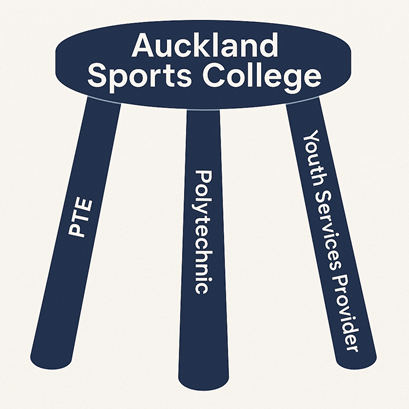 |
Youth Services Provider We have established relationships with a number of youth services providers, although a bespoke provider may be needed to provide tutoring, mentoring, and pastoral services to ASC students Private Training Establishment The distinctive aspect of this arrangement is that the Year 11-13 pathway to University will be overseen by a PTE that has sought, and obtained, NZQA consent to assess achievement standards in secondary school subjects such as Accounting, Biology, Business Studies, Chemistry, Economics, English, Geography, Health, History, Mathematics and Statistics, Physical Education, and Physics. We have enjoyed a positive relationship with Te Kura, the correspondence school, for a number of years but the time is right to move to a partnership model. Polytechnic The third leg of the stool is a polytechnic that can offer multiple vocational and academic pathways, recognising that a number of students may choose degree pathways at university. At present we support students at AUT, the University of Auckland, and Unitec. |
Auckland Sports College does not intend to hold accreditation. It will incorporate as a charitable trust and act as an umbrella.
Why Move Away From the Established Secondary-Tertiary Model?
The gap between Year 13 at school and the first year at university is entirely artificial and unnecessary. For students proceeding to university, a lot of content is just taught and examined for a second time. For students proceeding down a vocational pathway there is no coherent transition from the school trades academy to the polytechnic pre-trade or apprenticeship course. We see Auckland Sports College as an attractive proposition to a number of groups of students
Overflow Students
If Auckland Sports College were located near large and growing schools, say at Unitec which is 2km away from both Mount Albert Grammar School and Avondale College, then ASC could relieve roll and infrastructure pressure.
Mainstream Students
Ordinary secondary schools contain lots of pesky Year 9 and 10 students. A tertiary environment is quite different from a school environment.
Students who want to change lanes
Auckland Sports College will provide academic flexibility for learners who have not met course prerequisites or wish to change academic direction.
Within the tertiary system, ASC will offer bridging, catch-up, and re-alignment pathways that allow students to rebuild their NCEA profile and re-enter health, sport, business, STEM or trade streams.
This flexibility is unavailable in traditional secondary settings and directly supports national goals to lift NCEA Level 2 and UE attainment.
Disengaged Students
Every large secondary school struggles with students who “age out” emotionally, socially, or behaviourally at 16–17, long before they’re ready for work or tertiary study. They’re not failing intellectually — they’re failing to fit within the institutional culture of school. Thee student have grown out of school, but have not yet grown into the workforce. They are usually aged 16–18, still eligible for school but increasingly alienated by its structure. They are often bright, independent-minded, or practically inclined but are frustrated by: Uniform rules, attendance requirements, hierarchical discipline, lack of agency or voice, and school cultures focused on compliance rather than capability. Many have attendance issues, disciplinary referrals, or disengagement flags, but they are not inherently “at risk” — they simply want to be treated as adults. These are often the learners who flourish once they move into a tertiary setting with adult expectations, flexible timetables, and greater autonomy.
NEET Youth
Students who are not enrolled, employed, or engaged in training are a diverse group. Those who wish to complete school qualifications and perhaps move into tertiary study may do well in a tertiary environment,
Students - too old for school at age 16-17
Auckland Sports College will provide an alternative environment for 16–18-year-olds who have become disengaged from the rigid structures of school but are not ready to transition directly into employment.
The College’s adult learning culture, flexible timetables, and sport-focused programmes will re-engage these students, enabling them to complete NCEA and vocational qualifications in a tertiary setting where they are treated as young adults.
Students with jobs
Auckland Sports College will also cater to learners whose employment or family responsibilities make full-time secondary schooling impractical.
The College’s flexible timetable and blended learning model will enable these students to remain in education while working part-time, ensuring they can complete NCEA Level 2 or 3 and transition into further study or apprenticeships.
Serious Student Athletes
Auckland Sports College will cater to young athletes whose training and competition schedules make traditional schooling impractical.
By operating within the tertiary system, ASC offers timetable flexibility, professional coaching partnerships, and an integrated academic–athletic model similar to international high-performance academies
Students - "repeaters" and adult students
Students who are aged under 19 but have completed five years of secondary education are often refused further enrolment at secondary school as Year 14 or Year 15 students. Older students who wish to complete NCEA also find it difficult to enrol at secondary school. We are here for them.
Students from the Pacific Islands
We see the potential for students from the Pacific Islands students to
study NCEA courses online during the year, then
travel to Auckland for an intensive 8–10 week block combining:
in-person NCEA assessment and NZQA externals (or Cambridge exams), and
elite training or academic enrichment,
before returning home with formal New Zealand credits and global exposure. For example, this could happen in concert with teams travelling to the Global Youth Sevens,
Students who want to try Cambridge exams
Not all schools offer Cambridge exams, and many of those who do, restrict entry to their "better" students.
Students who want to attempt a university paper or papers in Year 13
It is very difficult for a student enrolled at a school to enrol in a university paper, even if they have UE. For example, the University of Auckland enrolment regulations allow the university to terminate the enrolment of full-time secondary school students. Enrolment at a PTE avoids this hurdle.
What About Sport?
Auckland Sports College is a sports college, but its students in Years 11-13 will not be eligible to participate in secondary school sport as ASC is not a school.Auckland Sports College would compete in "University and Tertiary Sport NZ" competitions.
We will attempt to establish our own "Super Sport" competitions.
There are a number of sports in which schools play almost no role in development or competition. These include: Boxing, Mixed Martial Arts (MMA), Combat sports (kickboxing, judo, wrestling), Weightlifting / CrossFit, Athletics / track and field, Cycling, motorsport, equestrian, golf, surfing. Athletes in these sports train in private gyms, clubs, or academies, not at school. Their competition calendars are often national or international, not term-based.
For elite athletes an ordinary school can be a problem. Jacko Gill provides an example. When he was at Takapuna College, his world-class shot-put training schedule didn’t fit school timetables or attendance requirements. He needed: Two training sessions daily, International competition travel, Recovery, nutrition, and strength conditioning blocks that didn’t align with “period 1–5” scheduling. Many young athletes in similar positions (swimmers, track cyclists, boxers, golfers, rowers) face the same dilemma: the more serious they become, the less compatible traditional schooling is with their development. The current solutions — distance learning (Te Kura), online schooling, or flexible attendance agreements — tend to be isolating and academically weak.
We don't see the lack of access to inter-school competition as a problem for rugby league players. The Auckland club competition is strong, and there are two evenly-matched NZ under 18 teams (schools and clubs).
It is pretty clear, given that the New Zealand Secondary Schools Rugby team has been smashed by the Australian Under 18 team, that teenage club rugby will become bigger.
Why a PTE and not a school like Te Kura?
A major structural failure of our current schooling system is the failure to recognise that 17 year olds are not just big seven year olds. What works for a group of seven year olds does not always work for 17 year olds. The structure of secondary schooling in New Zealand was never designed around the developmental, social, and cultural realities of today’s 15–17-year-olds. It evolved as an extension of the Victorian primary school, not as a purpose-built adolescent learning environment.When the Education Act 1877 created a national system of free, compulsory, and secular education, it applied only to primary schooling (ages 7–13). The state’s goal was basic literacy, numeracy, and civic discipline, not adolescent formation. Secondary schools of the 1880s–1920s were elite grammar schools or church colleges, preparing a small academic minority for university or civil-service exams. For everyone else, schooling effectively ended at 13.
When universal secondary education was introduced in the 1940s–50s, policymakers didn’t design a new adolescent model — they simply extended the primary system upward: same calendar, same daily structure, same hierarchical teacher–pupil relationship. The only difference was subject specialization and exams.
So even in 2025, the architecture of a “typical” New Zealand secondary school — bells, timetables, classrooms, teachers as gatekeepers, short periods, centralised assessments — is a nineteenth-century operating system running on twenty-first-century bioware.
The result is the well-documented pattern of disengagement at 15–17, particularly among Pacific, Māori, and working-class youth. Attendance falls sharply after Year 10. Suspension and non-attendance correlate with boredom, irrelevance, and lack of agency rather than inability. Many capable students leave because school structures are incompatible with paid work, elite sport, family obligations, or entrepreneurial aspirations. These students are not “failures of education” — they are failures of fit between an outdated institutional model and modern adolescent realities.
What we are articulating reflects a shift that international scholars such as Ken Robinson, Gert Biesta, and David Istance (OECD) have described as moving from “schooling as custodial childhood management” to “education as capability development.”